
India is a vast country with an amazing linguistic diversity!
In 2011, the last language census data confirmed more than 121 languages of India. Of these, 22 were scheduled, and the remaining 99 + languages were categorized under the non-scheduled category. Hindi is the most preferred official language. Because it is the first language of nearly 425 million people in our country.
To celebrate our linguistic diversity in the true sense, we need a multicultural education system that accommodates the native languages of India. Fortunately, our policymakers are on the same page. Because our National Education Policy 2020 digs deep into this topic. And the recent education policy gives a lot of importance to the regional languages in a child’s education. Do you know that your child can benefit in many ways by knowing additional languages, including the less discussed regional languages?
Let’s explore more about this topic, and figure out the actual importance of regional language in traditional/online schools.
WHAT ARE REGIONAL LANGUAGES?
As the name suggests, regional languages are the languages that are spoken by a smaller part/area or people in a country. For instance, regional languages like Gujarati, Kashmiri, Kannada, etc. are spoken mostly in specific parts of India.
WHAT IS THE IMPORTANCE OF REGIONAL LANGUAGE IN EDUCATION?
Let’s try to understand some points from the perspective of our policymakers i.e. The National Policy of Education, 2020.
EARLY CHILDHOOD EDUCATION
The National Policy of Education, 2020 focuses on Multilingualism and the power of language under point 4.11. The policy states the importance of the mother tongue or the home language to teach nontrivial concepts from the formative years of formal education till grade 5. This visionary policy also suggests using textbooks in home languages.
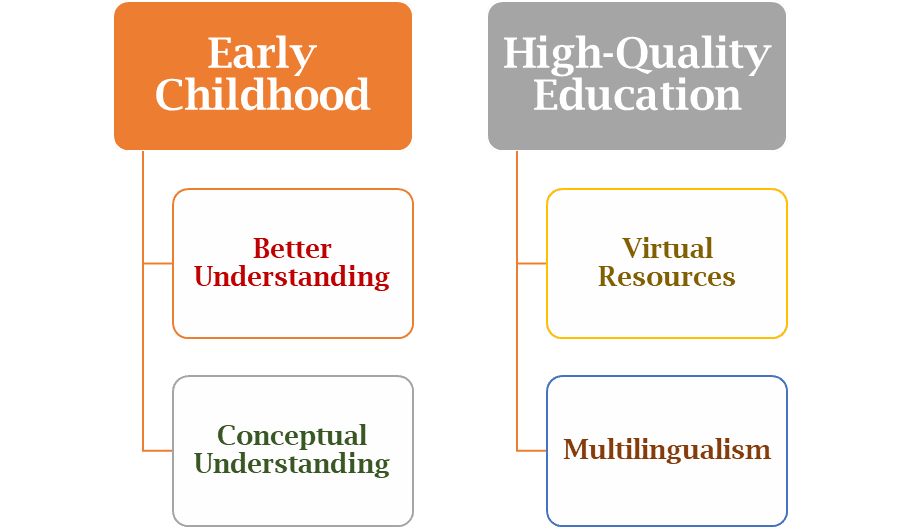
It is proved that bilingual teaching and learning material support better understanding in early childhood. Because young students connect to the languages spoken by their respective local communities easily (regional languages).
POPULARIZING LANGUAGES OF INDIA AND MULTILINGUALISM
Native languages of India also help in popularizing language learning across the country and promote national unity as well. It is also a wonderful way of harnessing the cognitive benefits of multilingualism in the right age. Because a child can learn new languages easily between 2 to 8 years of age (point 4.12).
IMPARTING HIGH-QUALITY EDUCATION
Home languages eliminate all types of language barriers. Hence, by incorporating a regional language in the curricula we can enhance the overall quality of learning and also improve the students’ capacity to grasp concepts. In this age of online schooling, our government categorically highlights the need to extend learning opportunities through virtual resources (online and printable versions of textbooks).